5
Ibtissam El Assad

Morocco–Netherlands: Green Hydrogen Bridge Powers Europe’s Industrial Transition

AN EXCLUSIVE INTERVIEW WITH:

Morocco–Netherlands: Green Hydrogen Bridge Powers Europe’s Industrial Transition

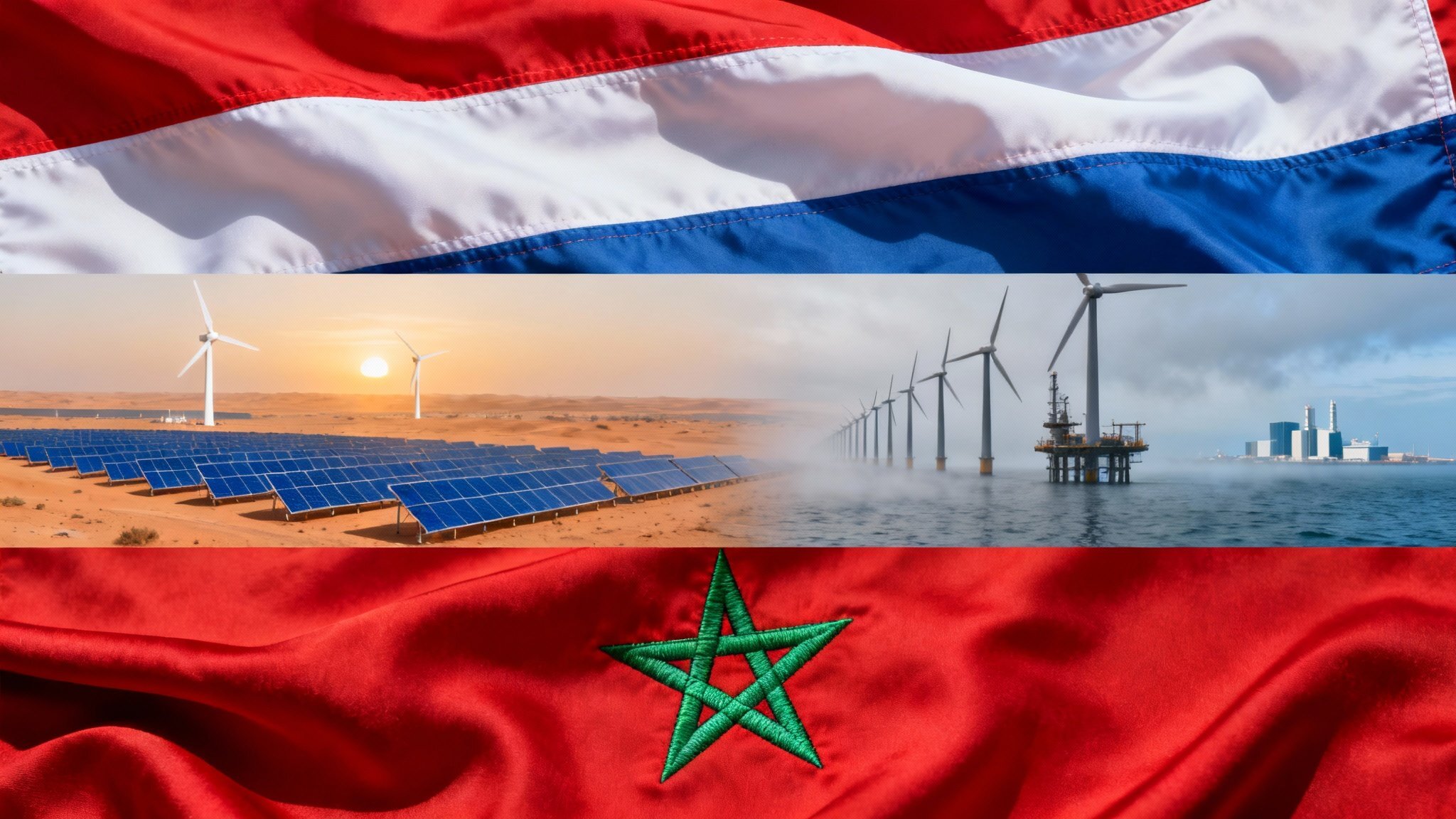
Morocco is set to become a crucial partner in Europe's clean energy transition, particularly for the Netherlands, as a strategic partnership aims to establish a "Green Hydrogen Bridge." This collaboration, moving from vision to volume, will be pivotal in meeting Dutch demand for renewable hydrogen by mid-century, powering Europe's industrial decarbonization efforts.

A strategic partnership moves from vision to volume

Tomas Olejniczak, Project Lead for Climate & Energy at the Netherlands Enterprise Agency, underscored Morocco’s emerging role in Europe’s clean energy security: Morocco will be a pivotal partner in meeting Dutch demand for renewable hydrogen by mid-century.

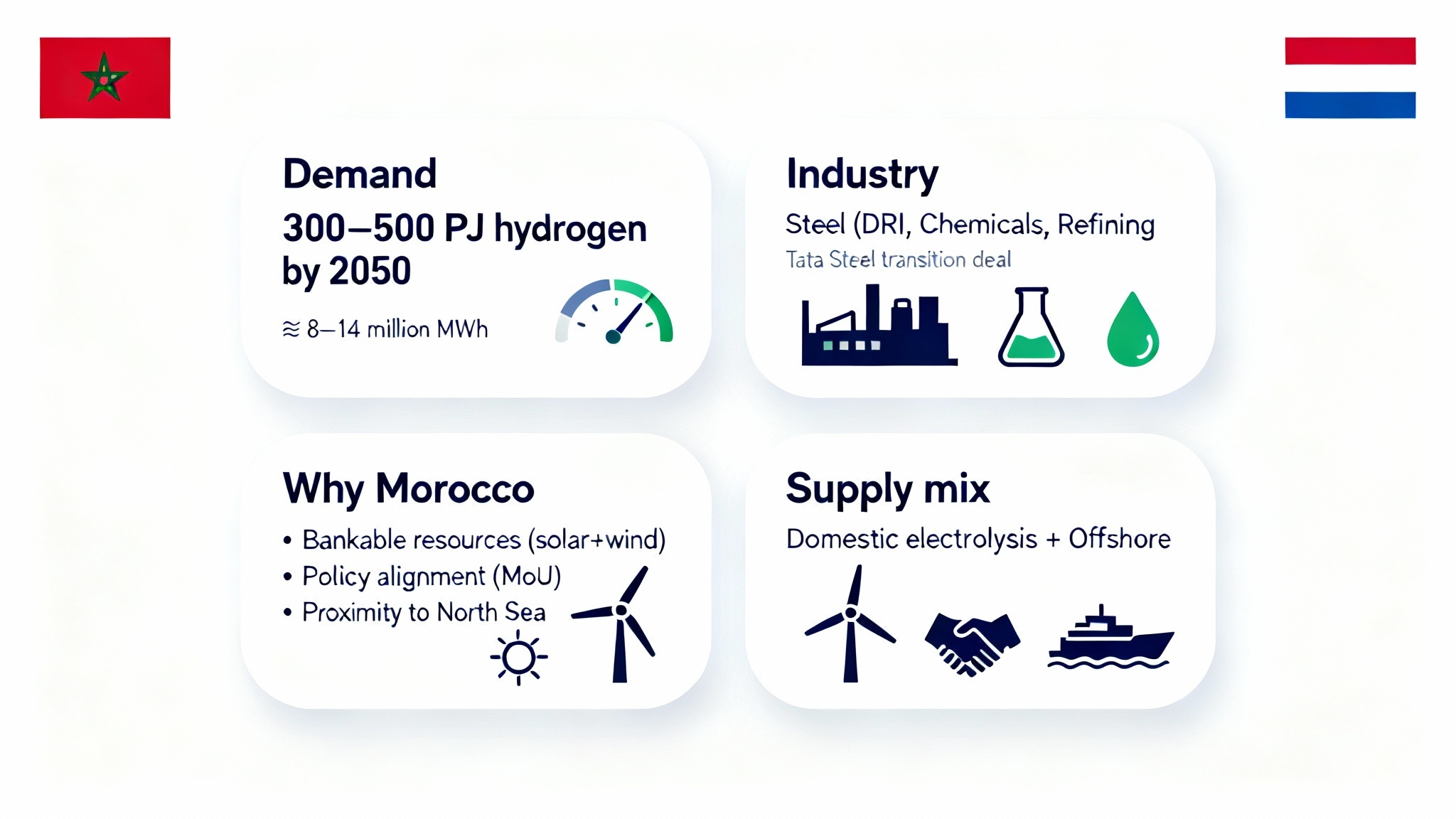
“Our national agency for applied science just released a study this week that we will probably be needing at least 300 petajoules of renewable hydrogen in 2050 and a maximum of 500 petajoules,” Olejniczak told Morocco World News. That scale equivalent to roughly 8–14 million MWh signals a decisive shift in the Netherlands’ energy system, from molecules to green molecules.

Why Morocco matters: reliability, resource, and reach

  • Bankable resource base: Morocco’s world-class solar and wind corridors provide the low-cost electrons needed for competitive green hydrogen and derivatives.
  • Policy alignment: A three-year Memorandum of Understanding between the Dutch Ministry of Economic Affairs and Morocco’s Ministry of Energy Transition is set for renewal of an institutional backbone enabling pilots to scale into bankable offtake.
  • Proximity to demand: Short maritime routes to North Sea ports and growing pipeline concepts position Morocco as a natural hydrogen and e-fuels supplier to Northwest Europe.

“Hydrogen is going to be a very important part of the Dutch industry of steel, chemicals, and many different sectors. So Morocco will be a very important partner for us,” Olejniczak said.

Dutch decarbonization ramps up: steel as a demand anchor

Momentum is already materializing in heavy industry. “Just a couple of days ago, our government signed a deal with Tata Steel to basically green the Dutch steel plants. This is going to be a multi-billion euro investment. Hydrogen is going to be a very big part of it,” Olejniczak noted, adding that the Netherlands hopes “to use some of the Moroccan hydrogen to support this transition as well.”

  • Steel transformation: Direct reduced iron (DRI) with hydrogen will progressively displace coal-based blast furnaces, creating stable long-term hydrogen offtake.
  • Chemicals and refining: Ammonia, methanol, and refinery hydro treating represent additional, sizable sinks for renewable hydrogen.
  • Systems integration: Dutch offshore wind, domestic electrolysis, and imported hydrogen from Morocco will collectively de-risk supply and smooth price volatility.

MoUs to molecules: what’s next

To turn diplomatic frameworks into delivered cargoes, several enablers must converge:

  • Bankable offtake: Long-term contracts indexed to European carbon prices can underwrite Moroccan project finance.
  • Certification: Robust Guarantees of Origin and sustainability standards will ensure traceability from Moroccan renewables to Dutch industry.
  • Logistics: Near-term ammonia and methanol shipping can bridge the cost gap, while mid- to long-term pipeline options may emerge as volumes scale.
  • Co-investment: Joint R&D, port infrastructure, and storage buildouts on both shores will compress timelines and reduce cost of capital.

A blueprint for trans-Mediterranean energy cooperation

The Netherlands’ quantified hydrogen needs 300 to 500 PJ by 2050 offer clarity and confidence to project developers. For Morocco, this demand signal validates its strategy to monetize abundant renewables through value-added hydrogen and e-fuel exports. For Europe, it’s a practical pathway to decarbonize hard-to-abate sectors without compromising industrial competitiveness.

If the next three years prioritize bankable offtake, certification alignment, and port-to-plant logistics, the Morocco–Netherlands corridor could become a flagship model for clean molecules trade accelerating Europe’s industrial transition while anchoring Morocco as a global leader in renewable hydrogen.

RELATED POSTS

August 28, 2026
Article

Argentina’s Mining Exports Jump 74.4% in Early 2026

Argentina’s mining exports rose 74.4% to US$4.742 billion in early 2026, led by gold, silver and rapidly expanding lithium production. The next challenge is to turn this growth into an integrated Andean mining platform through better infrastructure, Pacific access and cross-border cooperation.
August 27, 2026

Phosphates Come Home: What OCP's $450 Million Louisiana Bet Means for US Food Security and Moroccan Industrial Strategy

27 August 2026, London (The Net-Zero Circle by IN-VR) — Morocco's OCP Group and CHS Inc., the largest farmer-owned cooperative in the US, have announced a joint venture to build a $450 million phosphate fertilizer plant in Louisiana, the first facility of its kind constructed in the United States since 1984. With a capacity of over 1 million tons per year, the project aims to cut US reliance on imports, which currently cover roughly 40% of the nation's phosphate fertilizer needs.
September 2, 2026
Article

Argentina’s RIGI Unlocks Critical-Minerals Investment

Argentina’s RIGI framework is making large-scale critical-minerals projects more investable and predictable. Copper now represents the largest share of approved mining investment, while lithium remains a major growth opportunity. The wider opportunity includes energy, infrastructure, processing, technology, finance, logistics and other services.