5 min
Firas Boufaden

Argentina’s RIGI Unlocks Critical-Minerals Investment

AN EXCLUSIVE INTERVIEW WITH:

Argentina’s critical-minerals opportunity is entering a more investable phase. The country’s RIGI investment regime is giving large-scale projects a clearer framework, while the latest approved-project data shows a significant shift: copper has overtaken lithium as the largest mining investment theme within RIGI.

This does not mean lithium is losing importance. It means Argentina’s opportunity is broadening from lithium production to a wider industrial ecosystem involving copper, energy, infrastructure, processing, logistics, technology, finance, and supply-chain services.

Copper leads the approved RIGI mining portfolio

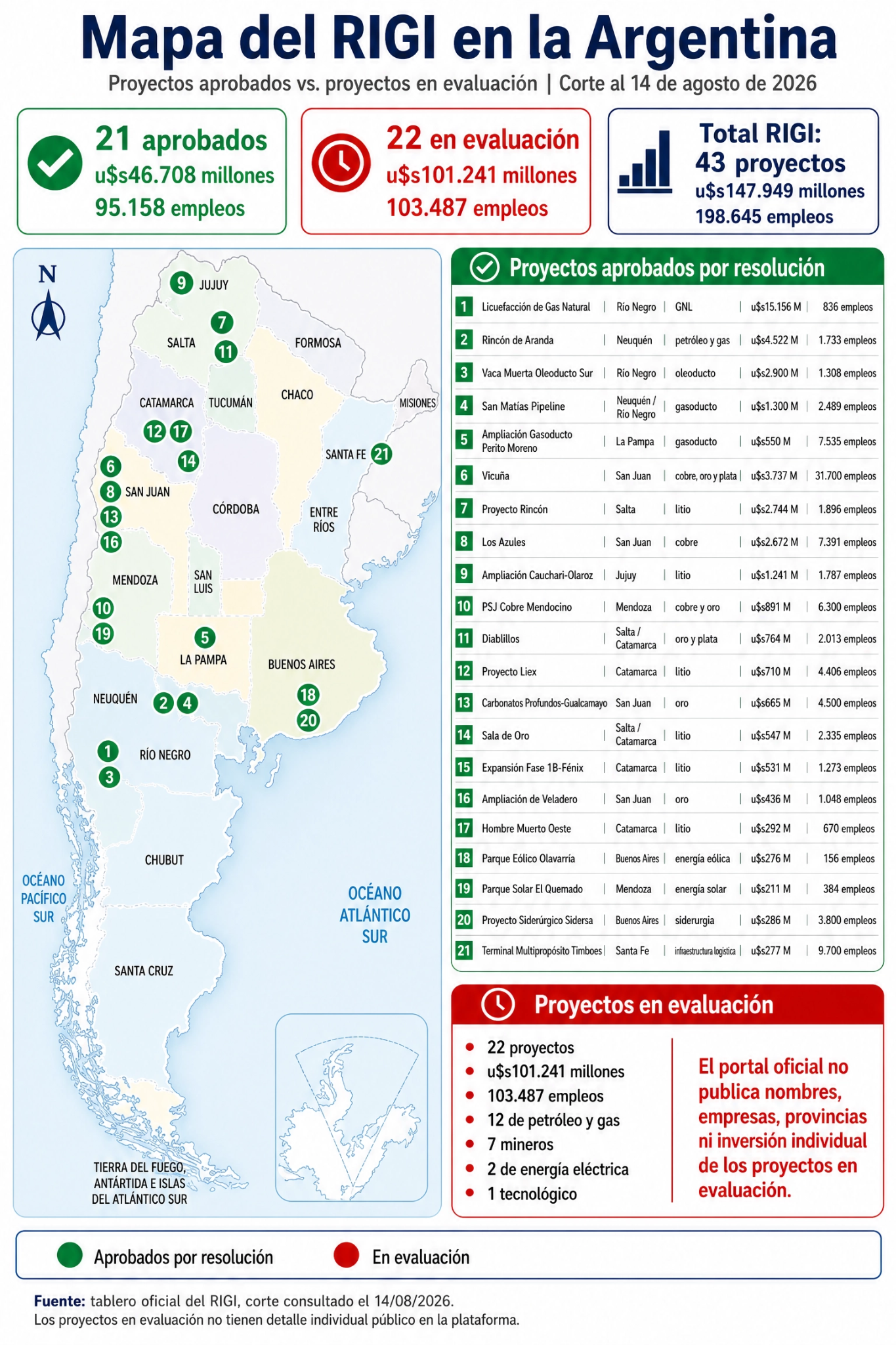
A 14 August 2026 snapshot of Argentina’s official RIGI dashboard, reported by Ámbito, identified 12 approved mining projects representing approximately US$21.23 billion in planned investment. Copper projects accounted for about US$13.3 billion, compared with approximately US$5.787 billion for lithium.

The largest copper projects include Vicuña in San Juan, with a reported investment plan of US 2.672 billion; and PSJ Cobre Mendocino in Mendoza, with approximately US$891 million.

Their development could require concentrators, processing facilities, power systems, water infrastructure, roads, skilled workers, and export links.

These figures represent approved investment plans, not money already spent, completed construction, or guaranteed production. Each project still faces financing, permitting, engineering, construction, operating, market, and social-performance risks. Even so, the size and composition of the portfolio provide a meaningful signal for companies assessing where new industrial demand may emerge.

What RIGI offers large-scale investors

Created under Argentina’s Law 27.742, RIGI is designed to attract large domestic and international investments in strategic sectors including mining, energy, infrastructure, technology, steel, forestry, tourism, and oil and gas. It is therefore broader than a mining incentive alone.

For qualifying projects, the regime provides a fixed 25% corporate income-tax rate, accelerated depreciation, customs benefits for eligible imports, and legal and regulatory stability for 30 years from adhesion. It also establishes requirements concerning minimum investment, early capital deployment, local suppliers, project assets, and long-term export projects.

Benefits are phased. Under the government’s published framework, export-duty exemptions generally begin from the third year of adhesion, while foreign-currency availability increases progressively. Projects classified as Proyectos de Exportación Estratégica de Largo Plazo, or PEELP projects, can receive accelerated treatment but must meet higher investment and export criteria.

For investors, RIGI’s importance is not simply the tax rate. It may help companies build long-term financial models around a more predictable framework for capital-intensive projects that can take years to generate significant export revenue.

Lithium remains a major expansion opportunity

Lithium continues to be one of Argentina’s most important investment themes. In May 2026, Lithium Argentina announced that its Cauchari-Olaroz Stage 2 expansion had received approval from the RIGI Evaluation Committee. The company says the expansion targets an additional 45,000 tonnes per year of lithium carbonate equivalent, building on Stage 1 operating capacity of 40,000 tonnes per year.

This is a company target for additional capacity, not a guarantee of future production. The project remains linked to environmental permitting, technical development, financing, construction, operating performance, and lithium-market conditions.

The project also demonstrates that RIGI may support expansion programmes connected to operating assets, not only greenfield mines. That can create demand for process technology, engineering, construction, chemicals, water management, power, maintenance, automation, transport, technical services, and long-term offtake arrangements.

The opportunity extends beyond mining companies

Argentina’s critical-minerals pipeline could create opportunities well beyond companies extracting ore or producing lithium chemicals. Renewable-energy developers and power companies may supply lower-carbon electricity, storage, and long-term power solutions. Infrastructure firms may participate in roads, transmission, water systems, rail, ports, and communications. Engineering, procurement, and construction companies may support mines, concentrators, processing plants, and related facilities.

Equipment manufacturers, automation providers, digital-service firms, financial institutions, private-equity investors, insurers, legal advisers, logistics companies, environmental specialists, workforce providers, recyclers, and manufacturers seeking secure access to critical-minerals supply chains may also find opportunities.


A company does not need to own a mine to benefit from Argentina’s mining expansion. It may enter as a supplier, technology partner, infrastructure investor, financier, service provider, processor, offtaker, or strategic partner.

Why companies should assess Argentina now

The investment case is not risk-free. Investors still need to examine permitting, provincial and community relationships, water availability, energy reliability, transport, labour, currency exposure, taxation, commodity prices, and project execution. 

However, waiting until every project reaches production may mean entering after key commercial relationships have already been established. The current stage is when companies can assess local partners, identify supply gaps, structure financing, evaluate technologies, and position themselves around the infrastructure required for the next generation of projects.

Argentina’s critical-minerals story is no longer only about how much lithium or copper the country can produce. It is also about who will provide the power, water, roads, processing capacity, digital systems, capital, equipment, logistics, skills, and partnerships needed to make that production possible.

For investors and companies seeking exposure to the energy-transition economy, Argentina deserves to be evaluated not as a single mining bet, but as a multi-sector market opportunity.

ARTICLES CONNEXES

August 28, 2026
Article

Argentina’s Mining Exports Jump 74.4% in Early 2026

Argentina’s mining exports rose 74.4% to US$4.742 billion in early 2026, led by gold, silver and rapidly expanding lithium production. The next challenge is to turn this growth into an integrated Andean mining platform through better infrastructure, Pacific access and cross-border cooperation.
August 27, 2026

Phosphates Come Home: What OCP's $450 Million Louisiana Bet Means for US Food Security and Moroccan Industrial Strategy

27 August 2026, London (The Net-Zero Circle by IN-VR) — Morocco's OCP Group and CHS Inc., the largest farmer-owned cooperative in the US, have announced a joint venture to build a $450 million phosphate fertilizer plant in Louisiana, the first facility of its kind constructed in the United States since 1984. With a capacity of over 1 million tons per year, the project aims to cut US reliance on imports, which currently cover roughly 40% of the nation's phosphate fertilizer needs.
September 2, 2026
Article

Argentina’s RIGI Unlocks Critical-Minerals Investment

Argentina’s RIGI framework is making large-scale critical-minerals projects more investable and predictable. Copper now represents the largest share of approved mining investment, while lithium remains a major growth opportunity. The wider opportunity includes energy, infrastructure, processing, technology, finance, logistics and other services.