Luana Torruella

Exclusive Interview: Genneia on Powering Argentina's Mining Sector Through Renewable Energy

AN EXCLUSIVE INTERVIEW WITH:
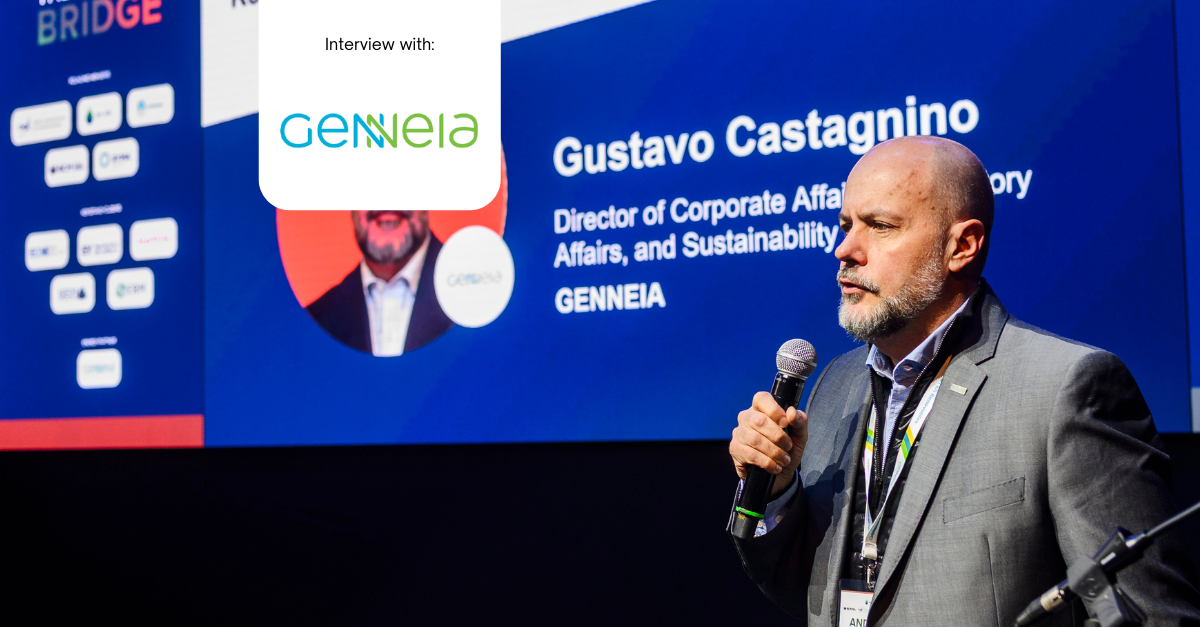
Gustavo Castagnino, Director of Corporate, Regulatory and Sustainability Affairs | ESG — Genneia

Genneia has consolidated its position as a leader in renewable energy in Argentina. What have been the company's key milestones in recent years that explain this leadership?

"Genneia is the leading company in sustainable energy solutions in the country, holding 23% of total installed renewable capacity. We have reached 21% of wind capacity and 26% of solar capacity, consolidating a leadership position in both segments. We operate 8 wind farms and 6 solar parks, enabling us to surpass 1,580 MW of installed renewable capacity, with a projection to reach over 1.7 GW in 2026.We are currently advancing new projects, including the construction of the San Juan Sur Solar Park (129 MW) and the Lincoln I and Junín I Solar Parks in Buenos Aires (20 MW each), as well as the development of our first energy storage project, aimed at optimising demand management.We supply more than 100 corporate clients through the MATER market, supporting them in reducing their carbon footprint. In parallel, we continue to strengthen our financial profile as the country's leading green bond issuer, with over USD 1.28 billion issued to date.All these milestones reflect the company's 14-year track record of developing and operating energy assets, with over USD 1.7 billion invested in large-scale renewable projects. With a long-term vision, our goal is to continue driving the generation of clean, efficient, and competitive energy."

In a context where mining is gaining prominence in the region, how is Genneia approaching energy supply for this sector? What role can renewable energy play in its development?

"The expansion of mining presents a particular energy challenge: it is not just about meeting demand, but doing so under demanding geographical and operational conditions.In this context, Genneia approaches the sector with an integrated perspective, designing tailored solutions that combine different sources and technologies according to each project's needs. This ranges from grid-connected schemes to hybrid or off-grid solutions, with the goal of ensuring reliable supply, optimising costs, and improving environmental performance. We also have the capacity to supply 100% renewable energy from our own generation assets and to offer interconnection solutions adapted to each operation.Renewable energy plays an increasingly important role — not only due to its competitiveness, but also because it allows mining projects to align with international sustainability standards.At Genneia, we seek to consolidate our position as a strategic partner for the mining sector, as we have been for the industrial sector for over a decade. We accompany the sector's growth with energy frameworks that deliver predictability, efficiency, and scalability, combining technical expertise, execution capacity, and a deep knowledge of the Argentine energy market."

From your perspective, what are the main challenges today in advancing greater energy efficiency within the mining industry in Argentina and the region?

"One of the key challenges is the available electrical infrastructure. The capacity to evacuate and transport energy directly conditions the development of new projects and the ability to incorporate more efficient solutions.Progress is also needed in regulatory frameworks that match the sector's investment dynamics, as well as in complementary technologies — such as storage — that allow for more efficient management of the variability inherent to renewable sources.Ultimately, energy efficiency depends on a systemic vision that combines infrastructure, regulation, and technology. Another central point is anticipating the growth of mining demand through long-term energy planning. Early coordination between mining developers and energy providers allows for more efficient solutions to be designed from the outset and avoids future bottlenecks."

What opportunities do you see to accelerate this energy transition in mining, particularly through stronger public-private collaboration?

"The opportunities are significant when coordination exists between all stakeholders. The alignment between the public and private sectors allows priorities to be ordered, uncertainty to be reduced, and long-term investments to be made viable.The challenge is to deepen that coordination so that infrastructure and energy solutions can anticipate the mining industry's growth. It is also key to develop mechanisms that can accelerate investment in electricity transmission and facilitate long-term contractual frameworks, which are fundamental for capital-intensive projects.Argentina has a significant opportunity to develop a mining sector that is increasingly integrated with the regional energy transition, leveraging competitive renewable resources and stronger coordination between investment, infrastructure, and energy planning."

The Andean Capital Forum aims to connect projects, capital, and key sector players. What value do you believe these spaces bring to advancing energy and mining development in the region?

"These types of gatherings serve a fundamental role because they connect the different stakeholders needed to turn opportunities into concrete projects. They also highlight that investor interest exists — especially in proposals that integrate sustainability criteria from the outset.For companies like Genneia, these spaces are also valuable because they allow us to exchange visions with different actors across the value chain and to think through energy solutions tailored to the specific needs of each project.The energy transition and mining development are increasingly interconnected, and in that sense, forums like this one help accelerate that convergence between energy demand, infrastructure, and capital."

Within the framework of the 'Andean Bridge' concept — which aims to structure and connect the project pipeline with capital — how do you see the role of energy, and renewables in particular, in that equation?

"Energy has become a structural component in the viability of mining projects. It not only impacts operating costs, but also access to financing and compliance with international standards.In this context, renewable energy provides predictability, competitiveness, and alignment with global market demands — given the growing requirement for projects that incorporate sustainability and energy efficiency criteria from the start. Renewables contribute to strengthening the environmental profile of mining developments and ensuring their long-term sustainability."

----

This conversation with Genneia has underlined how renewable energy is not merely an operational input for the mining sector — it is a strategic enabler of financial viability, environmental credibility, and long-term competitiveness. At The Net-Zero Circle and the Andean Capital Forum, we believe that fostering these dialogues is essential to structuring the convergence between capital, infrastructure, and clean energy across the Andean region.

ARTICLES CONNEXES

May 25, 2026
Interview

Exclusive Interview: Genneia on Powering Argentina's Mining Sector Through Renewable Energy

In this exclusive interview, Genneia — Argentina's leading renewable energy company — shares how it is positioning itself as a strategic partner for the fast-growing mining sector. With over 1,580 MW of installed renewable capacity and customised solutions combining solar, wind, and storage, the company is accelerating Argentina's energy transition while enabling more sustainable and competitive mining operations. Gustavo Castagnino underscores the critical role of public-private collaboration, infrastructure investment, and long-term planning in converging clean energy with regional mining growth.
April 27, 2026
Article

Morocco and France Are Building the Energy Partnership the Mediterranean Needs

27 April 2026, London (The Net-Zero Circle by IN-VR)--Morocco and France are deepening their energy partnership, with talks focusing on renewable electricity, green hydrogen, and cross-border power infrastructure. Morocco has committed to a coal-free future by 2040 and is positioning itself as a key clean energy supplier to Europe. This growing alliance is setting a new standard for Africa-Europe climate cooperation.
March 23, 2026
Article

Morocco's self-generation decree: what the regulatory shift actually means

23 March 2026, London (The Net-Zero Circle by IN-VR) -- Morocco's implementing decree for Law 82-21 now allows businesses and individuals to generate renewable electricity for self-consumption and sell surplus back to the grid, opening tangible commercial opportunities for solar developers and investors across North Africa.